What’s even the point anymore?
In a world where creating music has become as easy as the click of a button, it fair to ask “what’s even the point in creating anymore?”.
And I’m not alone in this, as many of my creative friends have confessed to me feeling what I can only describe as “a meaning crisis”. They don’t know what to create, and more importantly, why they should. They feel like AI (especially AI music) has stolen their soul. Some of them even question whether they should keep creating at all.
I’ve been thinking about it long and hard myself, but something inside of me just refuses to give up. Even if I’ve had shared feelings I feel I came out the other end with a perspective that hopefully helps fellow creators struggling to find their place in this weird, weird world.
We’ve been here before, kind of
In the early 20th century, German composers started to ask themselves a similar question: does music need to be beautiful to be valuable?
At the turn of the century, composers of the Second School of Vienna (Arnold Schoenberg and his students Alban Berg and Anton Webern) reached the endpoint of what traditional “tonal” music could offer compositionally. They started searching outside of it: atonal music, twelve-tone technique, serialism, and influenced composers later down the century to keep questioning every concept of what we thought we knew about music:
- What’s left after we break down the hierarchical structures of music?
- At what point does music differ from noise?
- Does music need to have rhythm?
- Does music require a “pre-written form” or can it be randomized?
- Does music need to be performed by a real human?
- Is it still music if it’s digitalized?
- What if the music has no harmony? What if it doesn’t have a melody?
One example of this is Schoenberg’s “Pierrot Lunaire”. The piece was premiered at the Berlin Choralion-Saal on October 16, 1912, and the music was so jarring that audiences rioted.
But here’s the thing: the answer they found was “music doesn’t need to be beautiful to be valuable,” but that finding also completely redefined our relationship with music itself. We took those learnings into the rest of the century which heavily influenced the development of jazz fusion, electronic music, ambient, experimental, and even cinema music.
Even if many of the musical experiments stayed in the early 20th Century, it’s undeniable that the change of perspective led to new genres and approaches we would’ve never thought about if it were not for those composers challenging the status quo.
But now we’ve hit a different wall
But now we are hit with a different question: if making beautiful music is now a commodity accessible to everyone, what becomes the determinant of value?
This whole AI revolution has forced us into rethinking the mindset of “product as the value” inherited from Modernism. It forces us to rethink how commercial value and personal value really meet.
It forces us to realize that the value of art and music may have never truly been in the final product itself.
It’s never been about the wav file.
When you think of it deeply enough, you realize that us, musicians, do not sell waveforms.
And that’s because the value was NEVER contained in the wav file.
I think we lost ourselves along the way a little, and AI is just a wake up call. We’ve been putting so much emphasis on creating the perfect product and getting the streams and the views, we really lost track of what makes music truly valuable. I believe that’s THE mindset that has prevented musicians from genuinely thriving.
What are we actually selling then?
It’s knowledge, culture, identity, feelings, belonging, connection, values and experience. Music is one of the purest forms of art by virtue of having no real physical form: it exists only in experience.
And I think that is why AI music angers so many people: because it’s never been about the quality of the files, but about the human connection and the experience itself.
AI music is a simulated experience; AI has never loved, never had their heart broken, never known hate or anger. It has never suffered or felt what it’s like to be hungry. The technically “best song” can never be created by AI.
It doesn’t matter if it sounds real, if it is not real, the experience is just not the same.
Your art being real IS the value
Your art being real IS the value. Period, end of conversation. Commercial incentives may have shifted, but there was never a moment of real doubt about it.
And that realization actually changes everything, because the focus can finally stop being on “trying to make it perfect” and can shift to “creating a human experience” that comes from real, lived experience. Music doesn’t have to be perfect, it just has to be real.
And this is exactly why I will never go back to delivering “just audio files”. This is why we make music: to share it with other humans.
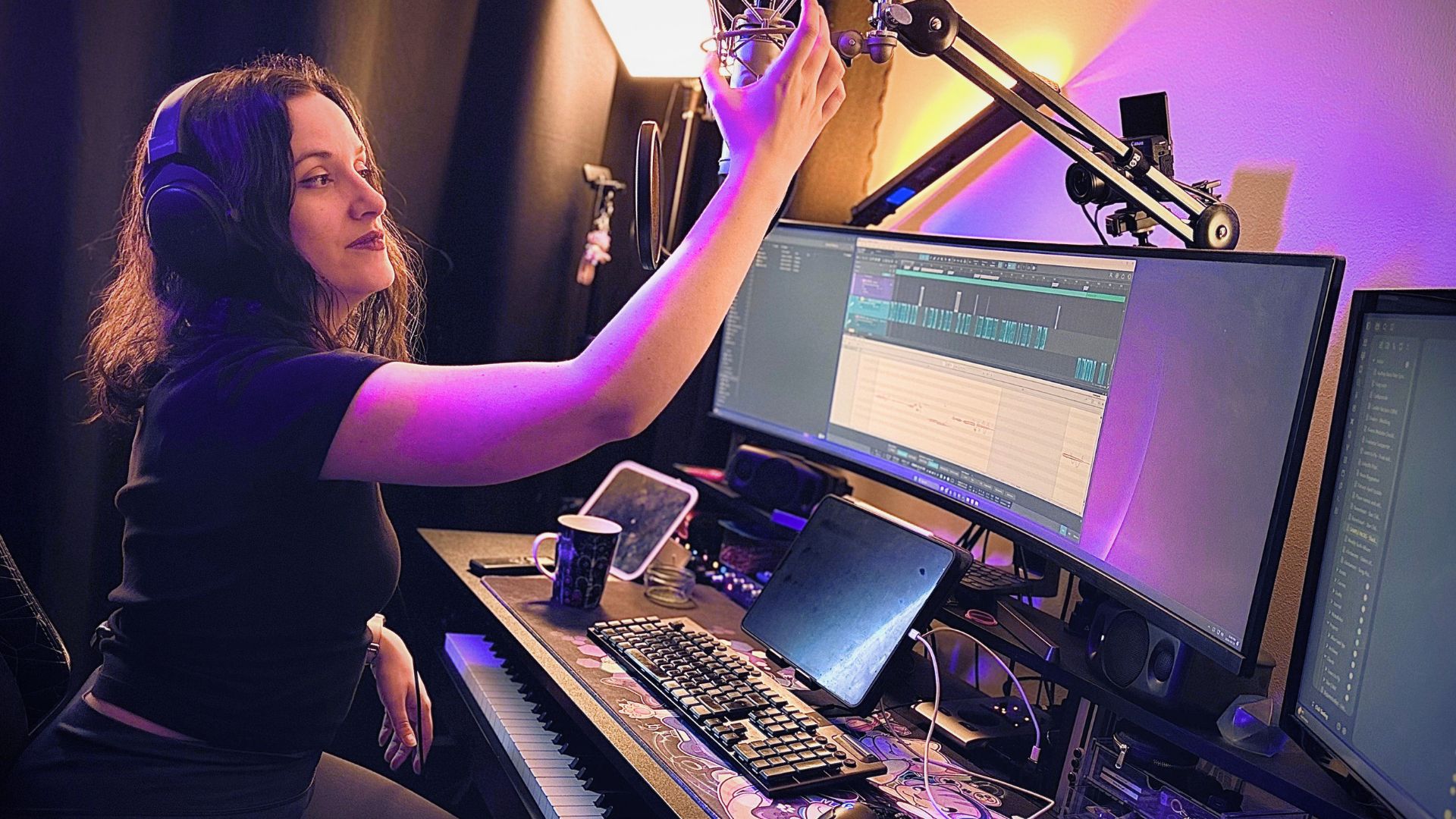
When I hop on live recording calls with my clients, something magical happens. We’re not just making music; I get to become that friend who actually gets it, and who gets to use her skills to help tell their stories.
We’re building something together, live, with all the imperfections and spontaneous moments that make it human. It’s the difference between ordering a product and sharing a lived experience with someone who cares.
That moment when we both realize we’ve captured that exact vocal line we needed, or the moment my voice cracks attempting something weird. Even if not all of it gets to the final song, the journey is 1000% worth it.
Because it’s actually not about the perfect take, it’s about two humans creating something meaningful together and having a blast.
I will never go back to just delivering wav files. If you want a wav file, AI can do it just fine.