When I recorded Legends from the Past, I was a very small YouTuber with fewer than a thousand subscribers, and I was not, in any meaningful sense, thinking about making an album, I was just thinking about surviving.
YouTube had recently overhauled its monetization policies, and smaller creators could no longer earn from their channels until they crossed a new, much higher threshold of a thousand subscribers and 4000 hours of watch time.
For years (actually, since about 2009), I was barely getting anyone to listen to my music, and spending an embarrassing amount of time trying to reverse-engineer an algorithm that showed no interest in what I was doing. So when the new policy was announced, I arrived at what felt like a perfectly logical conclusion: if one video gets 50 views, then two videos get 100. The solution, I decided, was volume.
In hindsight, I was a bit naive to think that it really mattered at this stage, as I was clocking less than 100 views per video at the time, but nonetheless I was ready to fight the algorithms with everything I had.
So I challenged myself to produce 1 video per day for a month, and somewhere in the middle of that effort, I sat down with my small electric lever harp in my living room in Montreal and recorded 15 improvised harp pieces back to back. I decided that if I made any mistake, I would repeat it twice so it would kind of look intentional.
Those recordings eventually became Legends from the Past. At the time, I considered them essentially throwaway material.
Those improvs, they were not recorded with any real technical intention. In fact, I only discovered after the session that I had left my C920 Logitech webcam microphone running the entire time, which meant that instead of capturing only the direct signal from the harp, the recordings had also captured the full sound of the room around me with this crappy webcam mic. The running time of the album, roughly 46 minutes, was basically also the time spent on composing, arranging and recording it.
It will come to no surprise that despite my best efforts, the videos were only a drop in the YouTube algorithm’s ocean.
Why Artists Assume Their Easiest Work Has No Value
Because it had all come so quickly and so easily, I assumed it could not possibly have real value.
And this, my friend, is one of the most obnoxiously prevalent myths in creative culture; that difficulty is the true measure of worth. If something demands years of revision and relentless self-criticism, then surely it must matter more than something that arrived without a fight. This belief operates mostly beneath the surface, but it shapes an enormous number of the decisions artists make and, more importantly, the decisions we don’t make.
At that same period in my life, I was struggling with what I considered my “real” work: the symphonic metal album I so desperately wanted to make. But to be totally real, at the time they were way more than I could chew; I didn’t really have the skills to quite pull it off at the level I needed; I was a singer with no experience playing any band instruments trying to write metal. That’s the job of about 7 musicians!
But I was so attached to this big vision I was completely blind to the things I WAS in fact, able to pull off… like this improvised harp music album! But perfectionism kept installing herself as a wall between my music and what I thought the world wanted.
Low and behold, over the years, I did learn to become better at music production, and I was finally able to pull off my EP: Through the Mirror, the music I had so dreamed of making. However, ironically, the harp album’s success far outshined any of what I thought should be me “real” music.
The Harp Album I Almost Never Released
For some reason, I just kept coming back to those improvs whenever I needed to focus on something and just wanted something easy to listen to in the background. I think the fact they didn’t follow a predicable beat or pattern and the fact they had no vocals contributed grandly to their appeal in my mind.
After some time (I think 1-2 years) it finally occurred to me that, if I was returning to these recordings on my own, then maybe some other listeners would enjoy them too for the same reasons?
And so I gave them a little cleanup up and a quick mix, and within a couple of hours I had an album ready to post. They were my first actual album release, and not at all the “perfect vision” of what I wanted to publish, but I thought if I don’t let go, I may never actually publish anything.
And almost immediately, people connected with them. I started getting emails from massage therapists telling me they would play my music during their sessions, content creators who wanted to use them (Hello Brittany!) and every time I engaged with people who knew me they would always tell me “Oh yeah, I still listen to your harp albums when I work/clean/study”!
Over time, my songs started being added to playlists, streams kept climbing, and Legends from the Past became my most successful release by a significant margin. As I’m writing this, this album has got approx 250k all-time listens and keeps getting over 5k listens per month.
It remains my most successful to this day. And I spent less time making it than anything else I have ever put out.
What 250,000 Streams Taught Me About Releasing Imperfect Music
That outcome forced me to sit with a question I had been avoiding: what if the work that feels most natural is, in some cases, the work that is most distinctly yours?
And, don’t get me wrong; creating an improvised album is not something one without the training or skills can do. It required a long time dedicating myself to this instrument. However, in doing so, we tend to forget to look back and really realize, as artists, how far we’ve actually gotten. So much so we stop looking at the stuff that’s “easy” to us as worthy of any attention.
Work hard on your craft, but also stop to remind yourself that there’s a version of you who could only dream of doing what you’re capable of doing now.
My Secret for Recording Without Fear
One of the big secrets for recording these improvs for me was that I approached it in a completely different way than anything I had done before: I expected mistakes, and just decided I was gonna roll with the punches.
This is what that looks like in practice: I made a rule for myself while playing that I would play my mistakes twice to make them sound more intentional. If I landed on a chord that sounded strange or unresolved, or if I accidentally made a string buzz with my nails, I leaned into it rather than backing away from it. The guiding question shifted from “is this good?” to “how can I make this work?”
Instead of hiding the imperfections, I started treating them as part of the musical conversation.
I think that’s the kind of transparency that creates a closeness that a highly polished recordings cannot quite achieve in the same way. We’ve all gotten used to perfectly performed, highly edited, and perfectly mixed music, with nothing unexpected thrown in. I believe it’s its own art form and I love it for what it is, but I also think in the music industry, we have forgotten that there’s a place for the real, raw, unpolished music moments that were never meant to sound the same twice.
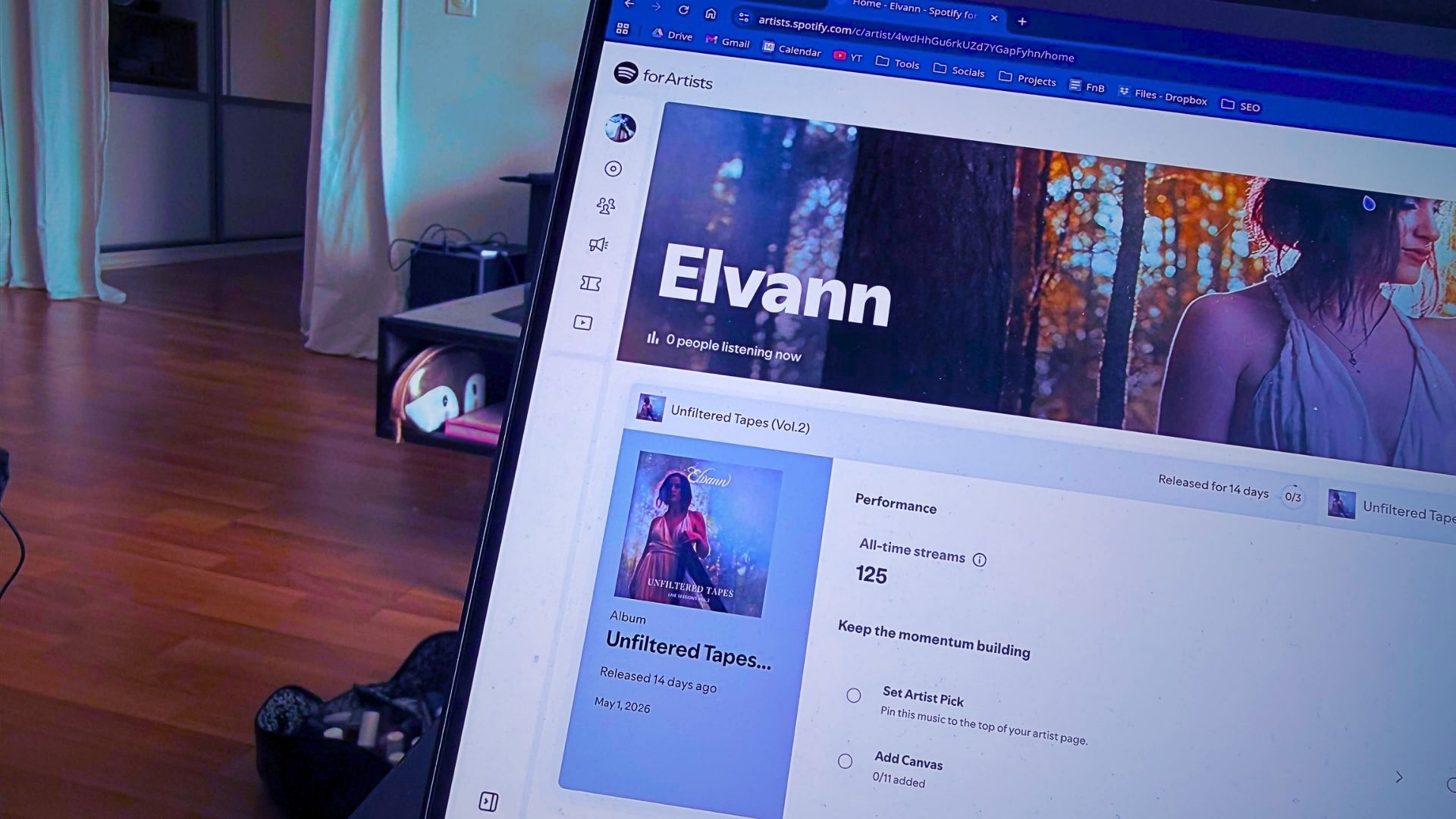
I suspect listeners are craving this more than artists tend to realize, especially in an era where music can be generated with the click of a button (see my article about why I think human music will always win). I feel like an album like this one, and my most recent releases (Unfiltered Tapes Vol. 1 and Unfiltered Tapes Vol. 2), are truly a breath of fresh air, precisely because the imperfections cannot be replicated.
As artists, we are so focused on proving ourselves worthy of attention that we tend to forget the real value of our own art.
That understanding reshaped a lot of how I approached my music afterward: I started being more open, spontaneous, and a lot less fearful of what people would think if what I made wasn’t perfect. I even started to embrace those mistakes as an addition rather than a distraction. I started making what I eventually came to call my “Live Sessions” on YouTube, and I think people have actually enjoyed them more than my more polished work.
Eventually, I recorded another improvisation-based album called Prison Glass, and while it did not reach quite the same numbers (66k all-time listens) as Legends from the Past (250k all-time listens), I had a much better time making it because I had stopped treating spontaneity as a shortcoming. I started to give myself permission to really enjoy the process.
Stop Waiting: Why Musicians Need to Release Their Music
I know for a fact (I’m looking at YOU!) that a lot of artists are sitting on work that is absolutely fantastic, give or take a few finishing touches, and that is ready to exist in the world. Don’t get me wrong, quality is important, but our standards tend to be distorted by fear in ways that are very difficult to see clearly from the inside.
If it doesn’t scare you just a little bit, then maybe you’re sitting way too deep in your comfort zone, and maybe it’s time to challenge that.
The most insidious thing about perfectionism is that it usually feels “responsible.” But are you really, truly guided by your artistic vision, or is that just your fears in a trench coat? Are you protecting your work, or just yourself?
Building a body of work matters, and the thing you have been sitting on because it doesn’t feel quite ready might be exactly what someone else needs to hear today.
Sometimes the recording you almost never posted is the one that actually changes your career. And sometimes the work you assumed had no real value was, in fact, the most honest thing you had made yet.